

Egyptian waling onions are great onions to have in the garden if they are hardy to your garden zone. The leaves, the top sets, and the mother bulbs are all edible raw or cooked. I only eat the leaves, some top sets and some bulbs. I replant the top sets and leave the bulbs in the ground to keep growing. They do get bigger in the ground. I think after a few years the mother bulbs disappear in the ground. Therefore, it is good to keep planting the top onions to keep increasing the patch and have a replacement for the existing bulbs in the ground. The top sets and the bulbs don’t do well in storage. They are best left in the ground. In summer when the leaves are not growing, I eat some of the top sets and a few of the mother bulbs. I have been growing them since 2014. When you let them set top onions, in a few years you will have a lot of them in your garden. Each plant produces on average 3 top onions or more. Some produce a lot of small onions on top and some produce 3 or so big top onions.
Growing perennial vegetables that are hardy to your zone allows you to have greens early in spring where your annual plants are not ready to harvest. In summer when your summer crops are ready to harvest, the perennials vegetables slow down production and set seeds. In fall when your annual vegetables are done producing, your perennial vegetables would produce again for you to harvest some greens before winter.
Perennial vegetables cover some gaps in your garden when annuals vegetables are not available.
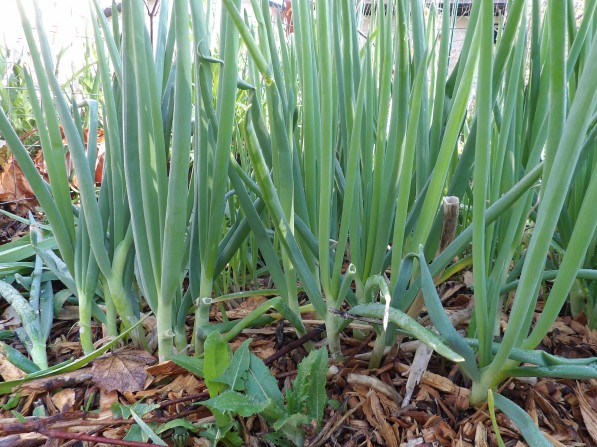
Egyptian walking onion spring growth
Egyptian walking onion starts to grow onion greens in early April in our zone 5A.
When to harvest Egyptian onion in spring?
You can harvest Egyptian onion greens for about 1 month in spring. It is usually May in our zone 5A. You can start in April when the green onions are about 1 foot tall. You harvest about 2 leaves for each plant, or you leave about 2 leaves on each plant. You harvest the leaves from the outer edge of the plant. They grow a stalk from the middle toward the end of May to carry bulbils. To avoid cutting that stalk by mistake, harvest the outer leaves.
In May it rains a lot in our zone, and we harvest most of our Egyptian onion leaves in spring.
Egyptian walking onion uses
You can eat Egyptian onion greens raw in your salad.
You can sauté onion leaves for your cooking just like you would use regular onion bulb.
You can harvest Egyptian onion leaves, rinse them, chop them, and freeze them in freezer bags for winter use. You can use the frozen onion leaves to sauté for your cooking.
In spring you can harvest the fresh leaves to use right away.
When to harvest Egyptian onion in summer?
In our zone 5A, Egyptian onion can start carrying growing stalk that will carry bulbils in late May.
In June, the stalks have bulbils on them.
By mid or late June, you can start harvesting a few bulbils for fresh eating.
In July, you could continue to harvest bulbils for eating.
In July, you can harvest Egyptian walking onion bulbs from the ground for eating. Try to harvest only a few of these. So that you have them to continue producing year after year.
Some Egyptian onion plants might carry few big bulbils while others might carry multiple small bulbils.
Some stalks might carry 2 rows of bulbils. The stalk might carry some bulbils at the tip and a stalk grows from the middle of these bulbils and carry few small bulbils.
Some bulbils might grow one green onion leaves at their tips.
Egyptian walking onion bulbs in the ground continue to grow bigger in size when left in the ground.
After a few years, some of these old bulbs may not come back in spring. So continue propagating them by planting the bulbils.
When to plant Egyptian onion in summer?
In August, when you see some of the mother bulbs in the ground starting to grow fresh green leaves, it is time to plant Egyptian walking onion bulbils.
When the stalks carrying the bulbils turned yellow or brown, it is a sign the bulbils on these stalks are not feeding from the mother bulbs. They can be harvested to replant.
The stalks carrying the bulbils tend to bend under the weight of the bulbils. When the bulbils touch the ground, they will root and start growing when the time is right for them. These bulbils on broken stalks or bent stalks can be harvested and replanted right away.
When you harvest the Egyptian walking onion bulbils, you can replant them right away in the area you want them. You do not need to wait to replant them in fall.
When to harvest Egyptian waling onion in fall?
You can start harvesting Egyptian walking onion leaves in September or when they reach at least 1 foot tall. You can continue harvesting onion leaves until November or while the supply lasts. Make sure to leave at least 2 leaves on each plant.
Conclusion:
Egyptian walking onion can growth in snow.
The first time I saw the plant, it was in my grandmother in-law front yard. I saw a leaf growing on the side of her building in a blanket of snow and asked which flower was growing in the snow.
My aunt in law said it was winter onion. She tried to harvest the bulb, but the ground was frozen, and she only pulled the leaf and the top of the bulb to give me. They told me they will harvest some later to give me to plant. At that point, I knew about Egyptian onion and as they continue to describe it to me, I noticed it that what I know as Egyptian walking onion, they call it winter onion.
In spring, we visited them, and my mother-in-law harvested a lot of bulbs from the ground for me. I planted them in my little garden in a duplex we rented at the time in 2014
When we purchased our house in 2014, during the moving in August, I harvested the Egyptian onion bulbs and dry them in the shade. When we moved to our house, the backyard had a garden area full of over grown flowers and wild plants. I made 2 beds on the grass in the front yard and planted the Egyptian onions. I planted some in the backyard when I was able to free a space around October. I have been growing Egyptian walking onion ever since.
Overtime, they replace regular onion bulbs in our cooking to the point that we do not purchase onions any longer. When we don’t have Egyptian onion greens to cook with, we just cook without.
We just keep eating the onion greens and let the mother bulbs in the ground to continue producing. We eat some of the bulbils and keep planting most of them. Overtime, we increased our onion path.
We grow them under our fruit trees, among our perennial vegetables, and throughout our food garden.
If Egyptian walking onion is perennial to your zone, it is a good perennial onion to plant in your garden.
I planted different types of onions in our garden over the years including:
Egyptian walking onion
Chives
Potato onions
French shallots
Greek shallots.
Only Egyptian onion and chives remain in our garden and kept coming back years after years.
Bunny can bother chives, but deer and bunny leave Egyptian walking onion alone.
The other onions (French shallots and potato onions) did well when harvested in summer to replant in fall. But when left in the ground, they rot over time due to rain in our area in late summer.
Greek shallot did ok in the ground but grew smaller bulbs as the clumps multiplied close to each other. Greek shallot bulb skin is hard to peel. Therefore, small bulbs were hard to use. Overtime, they disappeared in the garden.
It is ok to try the perennial onions you are interested in to see which ones will thrive in your zone and under your gardening style. In our low maintenance sustainable garden, only Egyptian onion and chives thrive.
Resources
Related article categories
Disclaimer:
“I am not an attorney to practice law. I am not allowed to draft legal documents, give advice on legal matters including immigration, or charge a fee for these activities.” I am not a CPA. Our contents are informative and based on our knowledge and experience. Use them at your own discretion.
Ads Disclaimer:
Ads are displayed in our contents. These ads do not influence the content we create and publish. We do not endorse them either.
Affiliate links Disclaimer:
Our Videos and articles contain affiliate links. When you click on them and make a purchase, we will receive a commission. We thank you very much for your support!
Our Vision
Nina’s Soap was created to help you live a healthy lifestyle within your budget while increasing your net worth.
Liberman Consulting L.L.C.’s contents are about different ways to save money, different ways to make money to reach your financial independence where you don’t worry about money or depend on your job to provide for your family.
Our Objectives
At Nina’s Soap (Liberman Consulting L.L.C.), you will find information about living a quality life within budget and increasing your net worth. Topics covered include personal finance, investment, business management, cooking from scratch, and growing some vegetables and fruit to save money and eat healthy.
Our content categories:
Personal Finance: Saving money, budgeting, investing, swing trading stocks
Cooking from scratch to eat healthy and save money: Grocery list, meal plan, sourdough starter, simple dishes.
Sustainable Perennial Food Garden Zone 5A: Low maintenance vegetables to grow to save money and eat healthy
Business management: Business tax, inventory management, business bookkeeping, making money online, IT.
Production: Sew to sell, YouTube content to make money online and to market your online store.
Self-Improvement: Work life balance, productivity.
“https://ninasoap.com/membership-join/ (We welcome you to join us. Email List)
care@ninasoap.com (contact info for any questions you may have)
https://ninasoap.com (blog), https://liberdownload.com (digital products), https://ninassoap.com (natural products), https://liberlabel.com (custom apparel), https://liberoutlet.com (resale store), https://www.youtube.com/c/LibermanConsultingLLC (YouTube Channel), https://www.pinterest.com/ninassoap/ (Pinterest), https://ninasoap.com/affiliate-products/ (Our resource page)”.